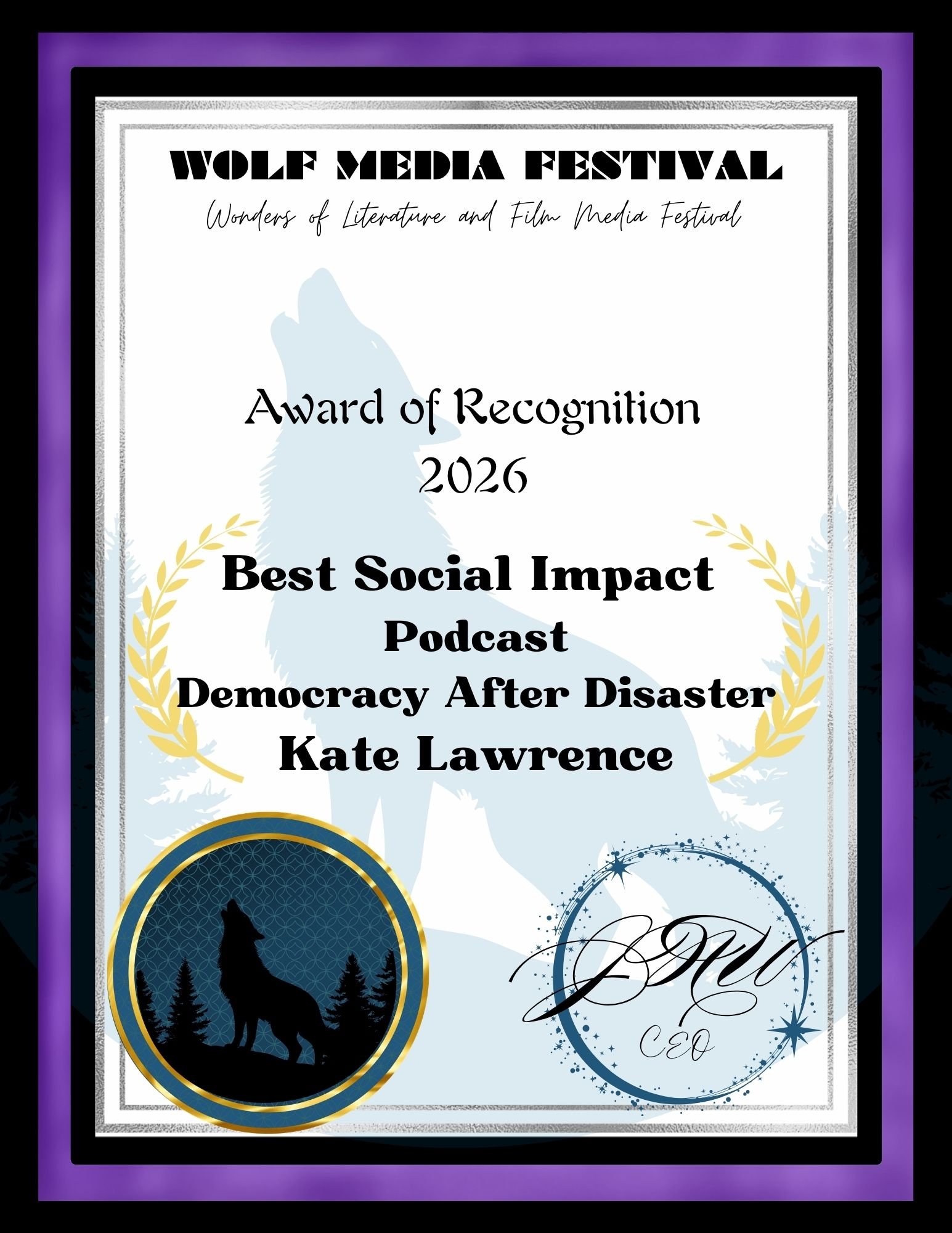
A narrative documentary podcast series about communities, government, power and recovery.
One of the things natural disasters do really well is rip away our sense of control. And so it's critical that the road of recovery is paved with voice and agency.
We need new ideas for how governments can share power, for how communities can step up and for how democracy works in the wake of a disaster.

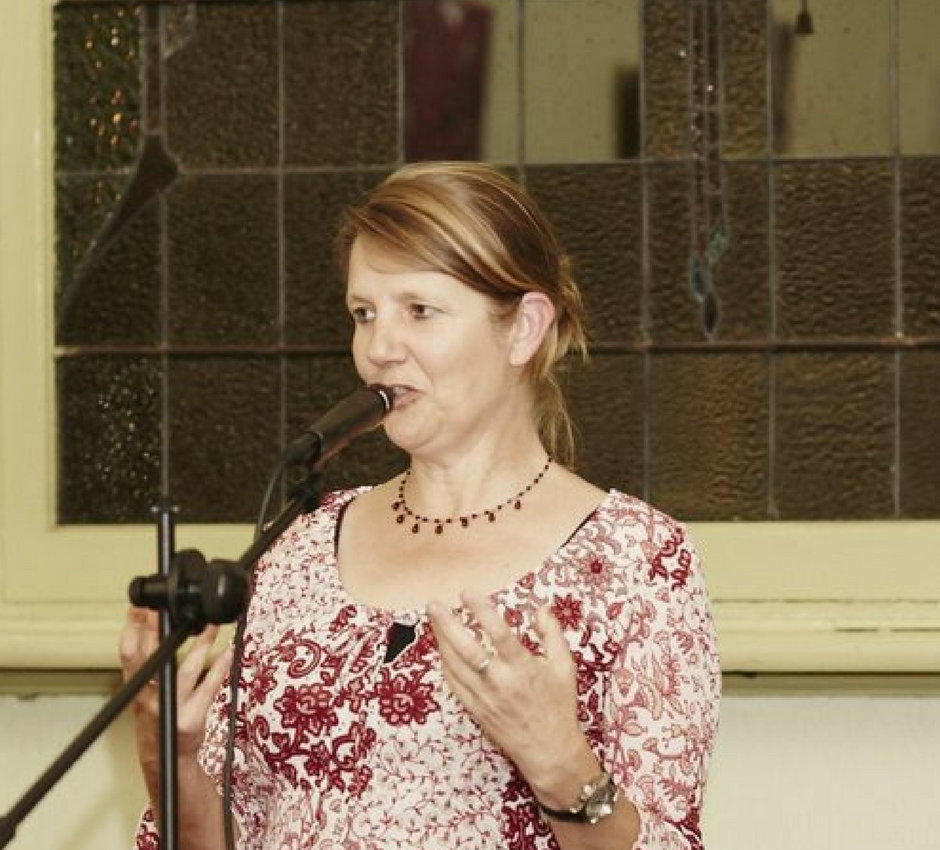
Over nine episodes documentary audio maker Kate Lawrence, also a former CFA educator and community recovery officer, will talk to people from Macedon to Mallacoota and experts in recovery, history and political science. And she'll explore concepts, structures and practical processes, that offer us ways we can dramatically improve our democratic path to recovery. There's no magic formula, but there are really good ideas we need to talk about and practice.
Year: 2025
Format: 9 episodes, between 42 and 66 minutes long.
This podcast was supported by a grant from the National Australia Bank.
In this episode we look at the Ash Wednesday bushfires of 1983 in Macedon, the home town of host Kate Lawrence, and the experiences of community leader Morna Kenworthy. We explore the complexities of recovery, the slow, bureaucratic government response and the pivotal role of the local community. We see how the contrast between the rigid structures of public administration with the flexible, ground-level initiatives led by ordinary people, highlights the clash between established systems and grassroots resilience.
In episode three of 'Democracy After Disaster,' we delve into the historical impact and aftermath of the devastating Black Friday bushfires in 1939, acknowledging the deep history of indigenous fire management practices, ignored by the colonists at their peril. The episode then tracks across the 20th century exploring changes in community-government relationships, the activism and experiences of Aboriginal and Torres Strait Islander people, and the evolving landscape of disaster recovery and democracy in Australia.
Episode 4 of 'Democracy After Disaster,' explores the aftermath of Australia's Black Saturday fires and the unfolding recovery, in Kinglake, a small town on the edge of Melbourne and an escarpment. We follow the experiences and thought lines of Kinglake resident Daryl Taylor, a deep political and philosophical thinker, and we roam across government capacity, neoliberalism, social evolutionary theory, disaster capitalism, and social capital.
This episode explores the story of recovery in Mallacoota after the Black Summer bushfires of 2019-2020. From a town divided for decades, we watch as the community of Mallacoota learns to step up, collaborate and develop a recovery plan that prioritises the environment and making sure no one is left behind. We also learn of the many ways the system thwarts community ambitions, and demands much in return for a community’s chance to lead their own recovery.
In this sixth episode of 'Democracy After Disaster', we hear the experiences of former recovery worker and self confessed democracy geek, Paula, who must navigate the system in order to do the public service work she loves. We get a glimpse of local government from the inside and hold it up to the light of democracy, and we start to see where solutions might lie if we are to improve our collective experience of recovery.
In Episode 7 of 'Democracy After Disaster,' we explore the intricate dynamics of power in disaster recovery. Examining the relationships between governments and communities, the episode focuses on the need for partnership, and how fostering democratic values encourages civic participation and tempers the corruption of power, leading to better community recovery.
In this eighth episode of 'Democracy After Disaster' we learn about ways we can better create space for meaningful conversations and inclusive decision making. On New Year's Eve 2019 the small town of Cobargo where Dave Newell lives, was devastated by bushfire. His story shares examples of participation frameworks like the Art of Hosting, Circle, and Open Space. We also discuss broader concepts like complexity theory, majority rule, and the significance of building relationships for effective recovery and decision-making.
In this final episode of 'Democracy After Disaster,' we hear about Dolly Parton's ‘My People's Fund” and its inspiration for a universal basic income (UBI) after a disaster. We look at the benefits of UBI, including mental health and social cohesion, and some of the common criticisms. We also explore participatory and deliberative democracy, highlighting successful examples and the potential for self-organizing systems in community recovery.

The 2009 Black Saturday bushfires in Victoria that devastated Steve Pascoe’s small community of Strathewen. While everyone pulled together, as people do the world over after a disaster, the folks of Strathewen were worried that the systems meant to help them, might instead further harm them. They set out to find a better democratic way to support them to recover and flourish again as a community.