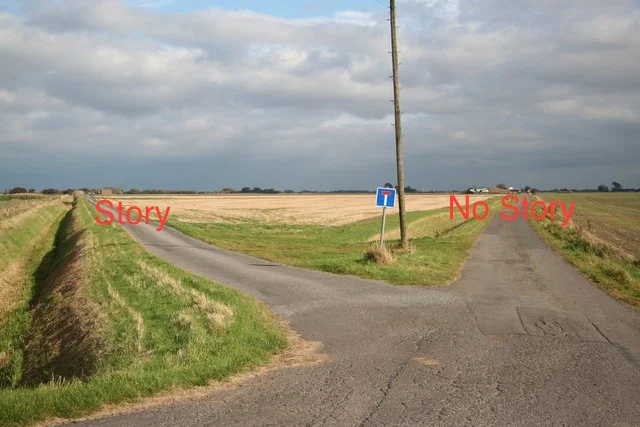
Story or No Story – Is That The Situation?

 Fork jn road with Story on one and No Story on other

I have this belief, developed from years of meditating and telling stories, that there are two states of being:  story and no story.  

I’m not given to drawing on the Bible, but I have pondered the first line of John ‘In the beginning was the word…’ (I did not know this was from John, I actually thought it was the first line of the whole book, but Google set me straight.)

Now apparently ‘the Word’ in this context actually meant Jesus (go figure), but it has often rattled around in my head as I try to understand the power of words; words are how we define and story the world.  

I want to scream this at people who scathingly refer to a meeting as a ‘bloody talk fest’.  We can’t do anything unless we imagine it first, and we can’t do anything with other people unless we talk about it.  

We are nearly always using words, even when we are not talking or reading or listening, we often think with words., although we also think in images, but we make sense of the images with words.

So it seems that when we don’t apply words to anything, we are without story, because we are without judgement.  When we use words we necessarily use judgement.  Words carry within them assessment, appraisal, meaning, and story, and the opposite also holds – when we have no words we have no judgement or meaning or story. 

And from my understanding of Buddhism, meditation and mindfulness, this is what we are aiming for when the Wise Sages urge us to be in present moment awareness, or mindfulness;  to observe without judgement.

And so, as my thought trails would have it, we have these two states of being – story and no story.

Does this make sense to anyone??  Or am I going bananas?

Love to hear your thoughts… 

Comments

6 responses to “Story or No Story – Is That The Situation?”

  1. Sam Avatar
    Sam

    Makes sense to me! Some meetings are just talk-fests but usually they are the ones without clear purpose.

    1. Kate Lawrence Avatar
      Kate Lawrence

      Yes, purpose, and good chairing/facilitation make all the difference to the effectiveness and enjoyability of a meeting. And unless I’m interested in the purpose and outcome of a meeting I am also probably thinking, ‘bloody talk fest’. But I am heartened by a firm belief that we are full of contradictions!

  2. Fionnuala Avatar
    Fionnuala

    Very interesting, thanks Kate. Before it was hijacked to only mean ‘logic’ the Ancient Greek word used in John’s gospel -λόγος – had many meanings including ‘word’. It also meant ‘expectation’, ‘ground’ and lots more. The essence of the meaning as John uses it – I believe – is that nothing exists in the reality of this world without first existing in the ethers – call it imagination, expectation, energy, whatever you like. Fits rather well with where, Kate, you say, ‘We can’t do anything unless we imagine it first’, don’t you think?

    1. Kate Lawrence Avatar
      Kate Lawrence

      Totally fits, now on to your much trickier other comment!

  3. Fionnuala Avatar
    Fionnuala

    A question for consideration – if one is born unable to hear or speak and does not learn to read – is one without story?

    1. Kate Lawrence Avatar
      Kate Lawrence

      This is a really interesting question, and my short answer is I don’t know. The longer musings are:
      I once mentioned my ‘story/no story’ theory in a group discussion and a woman took a strongly opposing view, saying that people with various mental illnesses do not fit either of these categories. I was not convinced, thinking that the stories and mean-making of a person with a mental illness are different from the norm, but not an alternate state. This of course is a little different from your example. Your idea makes me think of my ponderings about animals and whether they have ‘story’. Often people say that storytelling is a uniquely human experience, but I think of an animal that has learned something, like when its time for a walk, or when they are in trouble, and is there not some level of storying happening there, or is routine/habit/expectation something different?
      This of course leads to the question, the hoary chestnut of what is a story.
      But I have claimed in my blog, that without words we have no story. For your example, I think perhaps that interactions and communications with other people would enable storying. The more extreme and harder example to decide might be a person who has never lived with another human and therefore has no language. Would they, do they, invent a language of their own so they can story? And would someone who was unable to hard or speak do the same thing, creating a language of a kind?
      Perhaps a conversation to be continued tomorrow at Fabled Nights in Newport?
      But now I think I’ll have a little lie down….

Leave a Reply

Your email address will not be published. Required fields are marked *