
Worker disengagement is at extraordinary levels – in Australia, according to Gallup, over 75% of the workforce is disengaged, worldwide the figure is 87%.
While the causes and solutions for this epidemic in lack of workplace engagement are no doubt many, varied and complex, I want to suggest one cause/solution for this problem, relating to emotions.
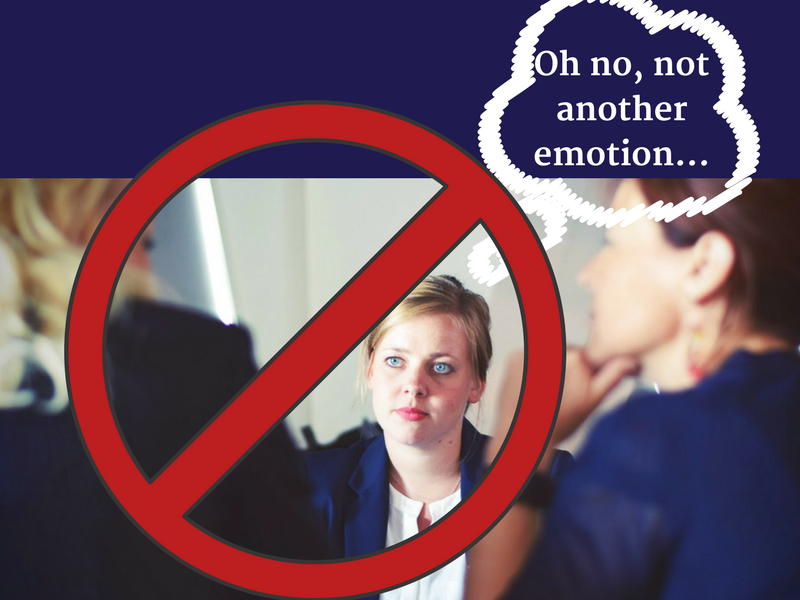
Emotions are not welcome at work, and it is an annoying inconvenience that despite this, they show up there anyway, unwanted and often without warning. As a result much is written, designed and developed to help us ‘manage’ our emotions at work.
A quick Google search of the term ‘emotions at work’ brings up a list, most of which have one of the following words in the title: cope, control, manage or handle. At the bottom of the Google page is a list of suggested search terms. They include:
-
how to separate emotions from work
-
how to control emotions at work crying
-
managing frustration at work
-
managing emotions in the workplace
-
what is emotional management
-
managing emotions at work
You get the picture. Expressing emotions at work is not professional. So we shut down, swallow, ruminate, suppress, numb, paper over and pretend we are not feeling anything or if we are, we are ‘fine’. This is the unspoken, accepted culture that is ‘work’.
Yet the evidence is clear – suppressing or numbing of some emotions, leads to the suppression or numbing of all emotions. We don’t have the ability to selectively suppress, we have one emotional gateway, and any barrier on it affects the flow of all emotions.
This means joy, delight, inspiration and engagement are all suppressed in the name of ‘professionalism’. And that lead to emotions showing up in other ways – in our bodies, vented at home, or in mental ill health.
Even workplaces that embrace a well-being culture usually do so with the idea of increasing the happy, positive emotions. This can inadvertently create a culture of ‘happiology’ – where if I’m not happy all the time there is something wrong with me. The cultural expectation becomes ‘happy happy joy joy’, leaving even less room to indicate that all might not be so rosy in my inner world.
There is of course a host of reasons the workplace has evolved to keep emotions at bay – emotions are messy – they are hard to predict, process, or express. They reverberate in unexpected ways, they can be overwhelming and destructive.
And yet despite all our attempts to eliminate them, emotions come with us, and need our attention – wherever we go.
Mental health issues are rampant in society and therefore they are rampant in the workplace. But because we aren’t meant to bring our emotions to work, we don’t have the skills, processes or tools, to deal with our own or anyone else’s human struggles. So we siphon common garden human emotion off into something done somewhere else with a stranger through an EAP program (Employee Assistance Program) or a private counsellor.
I am at the very beginning of a project, with a couple of others, to develop a pilot program that will go into a workplace to support workers to come together, with the strong but simple structure of the circle, to hold and enable emotional expression.
Oh yes, there are many questions, many potential pitfalls and risks, but so much to gain, such a clear and pressing need, we are deeply motivated. We have a small team, and we have a sponsor organisation. We have just begun the first stage of gathering information.
If you have an interest, resources, want to be kept in the loop for your organisation, get in contact, I’d love to hear from you. And if you have any thoughts or comments, please jump on below…

Leave a Reply